Atradius Atrium
Get direct access to your policy information, credit limit applications tools and insights.

 United Arab Emirates
 Australia
 Austria
 Belgium
 Brazil
 Bulgaria
 Canada
 China
China
 Czech Republic
 Denmark
 Finland
 France
 Germany
 Greece
 Group
Group
 Hong Kong SAR
 Hungary
 India
India
 Ireland
 Italy
Italy
 Japan
Japan
 Lithuania
 Mexico
 Netherlands
 New Zealand
 Norway
 Poland
 Portugal
 Romania
 Singapore
 Slovakia
 Slovenia
 Spain
Spain
 Sweden
 Switzerland
 Turkey
United Arab Emirates
Turkey
United Arab Emirates
 United Kingdom
 United States

Half of the sales that companies in Singapore make to business-to-business (B2B) customers are currently conducted on credit terms, well above the regional average, while the remainder are transacted with upfront payment. This is the highest share of credit-based B2B sales across Asia, a reflection of Singapore’s role as a regional and global trade hub. Large trade firms are more likely to extend trade credit to business customers than other segments in the market. Regional data show that businesses across Asia have increased their use of trade credit in B2B transactions in recent months, an upward trend that is also evident in Singapore. Trade credit supports sales, but wider use raises exposure to late payments and defaults. Careful receivables management is essential.
Singapore suppliers offer B2B customers shorter, more tightly managed payment terms than the Asia average. Most payments fall due within two months, often within one. Across Asia, payment terms are more varied, more often extending beyond two months from invoicing. This points to greater pressure on Asian suppliers to provide financing. Regional data shows that payment terms are lengthening across Asia to support B2B trade. Singapore follows the same trend, but more gradually, maintaining a closer balance between supporting sales and managing payment risk.
Far more businesses in Singapore than across Asia report that B2B payment behaviour has remained unchanged in recent months. This points to a more stable payment environment. When changes do occur, delays are slightly more common in Singapore than across Asia, suggesting some underlying pressure on cash flow. This is notable given Singapore’s tighter credit terms, which do not fully translate into stronger payment behaviour.
.2026-07-23-13-39-53.png)
Payment delays are widespread in Singapore, but their impact remains aligned with regional levels. Around four in five companies report delayed B2B payments, slightly above the regional average, with nearly one third of receivables overdue, consistent with the region. Mid-size trade and construction firms are hardest hit. Although Singapore suppliers maintain tight payment policies, survey data show some flexibility in how well these terms are met. Days Sales Outstanding (DSO) data confirm this, with a significantly higher share of B2B receivables collected more than two and up to three months from invoicing, even though very few invoices were originally set with those terms. Once overdue, most payments are settled within one month, limiting the build-up of long delays turning into credit losses. Data on bad debt write-offs show that more firms in Singapore than in Asia report credit losses affecting up to 2% of B2B receivables, mainly driven by customer insolvency or the inability to recover receivables, while larger credit losses are less common in the market than in the region. This suggests that credit risk is widely distributed but generally contained. Trend data highlight that payment risk in Singapore is more stable over time, with fewer fluctuations. Asia shows more volatility, meaning more companies report both worsening and improvement at the same time.
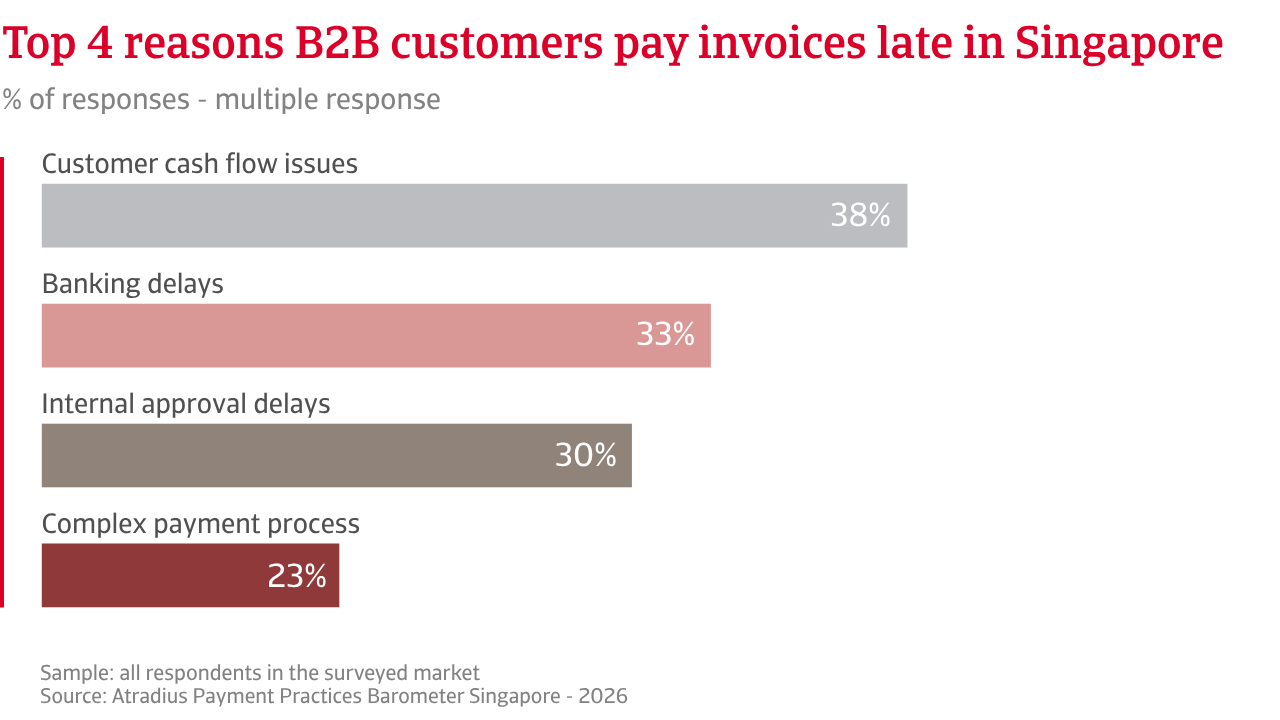
The drivers of late payments related to B2B trade differ between Singapore and the wider region. Notably, fewer firms in Singapore than across Asia report delays due to customer liquidity constraints. Instead, delays more often arise from internal processes, approval cycles, and invoicing issues. Banking system constraints are reported more often in the market than across the region, which may reflect complex processes or layered transactions, rather than weaknesses in the banking system. In contrast, Asia’s delays are more often tied to customer liquidity pressures and commercial disputes.
Although customer payment risk arising from B2B trade leads to cash flow pressure and planning challenges almost as often in Singapore as across Asia, firms in the market are less likely to rely on external financing or face higher funding costs as those across the region. Compared with Asia, the impact on investment is also less pronounced in Singapore. Even so, despite lower financial stress, some pressure still passes through the supply chain, with knock-on effects on payments to suppliers.
To manage B2B customer payment risk, Singapore firms rely on a more operational approach than their peers across Asia, with a stronger focus on automation and digital payments to reduce delays. To limit exposure to credit risk upfront, firms often request cash or advance payments or shorten payment terms, an approach that is broadly in line with regional practices. At the same time, Singapore businesses appear less reliant on intensive monitoring and collection frameworks. This choice of tools reflects different risk profiles. While across Asia, companies tend to hedge against more volatile, financially driven payment risk through reserves, credit insurance, and stricter credit management, businesses in Singapore rely more on process efficiency and operational control.
Half of the sales that companies in Singapore make to B2B customers are currently conducted on credit terms. This is the highest share of credit-based B2B sales across Asia, a reflection of Singapore’s role as a regional and global trade hub.

While businesses across Asia remain broadly optimistic about the outlook for B2B payment behaviour in the months ahead, suggesting confidence that liquidity pressures may ease and support more timely payments, Singapore firms show a more cautious stance, indicating that while some improvement is expected, they do not anticipate a sharp turnaround, but rather a steadier path ahead.
At the same time, there is little expectation of short-term easing in insolvency risk. Businesses in both Singapore and across Asia are almost evenly split between those expecting insolvencies to rise further and those expecting them to remain elevated, which points to a consistently high level of risk awareness. However, the way this risk is perceived differs. Across Asia, where payment behaviour is more volatile and more often linked to customer liquidity stress, these expectations reflect stronger concern about financial deterioration. In contrast, Singapore firms are less likely to anticipate worsening conditions and instead expect a prolonged period of elevated risk that they feel confident in managing.
.2026-07-22-12-54-12.png)
Survey data show that short-term profitability expectations are more cautious in Singapore than in Asia, where sentiment is more optimistic. This points to stronger confidence in growth and margin recovery at the regional level, even as risks remain elevated. In Singapore, businesses do not expect a sharp improvement in payment behaviour, while insolvency risk is seen as staying high rather than easing. Payment delays, though controlled, continue to weigh on cash flow and planning, reflecting ongoing pressure that tempers expectations for profit growth.
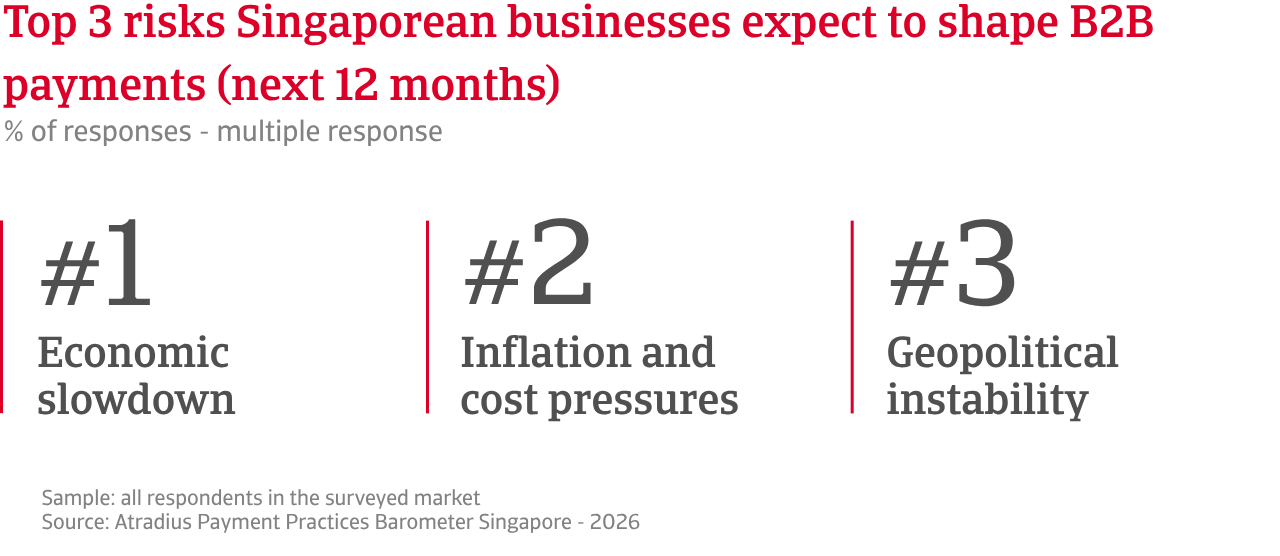
When asked about the main risks likely to disrupt B2B payment behaviour in the months ahead, companies in both Singapore and across Asia cite inflation and economic slowdown, highlighting the central role of demand and liquidity pressures. Singapore shows a similar pattern, but with stronger focus, pointing to heightened sensitivity to shifts in global demand. Where the two diverge is in the type of risk perceived to have the greatest impact.
In Singapore, concerns shift more towards external and structural factors. Geopolitical instability stands out, cited more often than in Asia, reflecting the country’s strong integration into global trade. Regulatory changes are also mentioned more frequently, alongside slightly higher concern about supply chain disruptions and currency volatility. Fraud risk is similar across both markets, indicating a shared and constant concern rather than a differentiating factor.
In contrast, financial conditions play a larger role across Asia. More firms cite interest rate increases than in Singapore, suggesting greater exposure to borrowing costs and financing constraints. Asia also reports higher concern about cybersecurity, pointing to a broader and more complex risk environment. Overall, this highlights that B2B payment risk in Asia is more financially driven and volatile, while in Singapore it is more stable, but still exposed to external shocks.
For a full overview of the 2026 survey results for Singapore, please download the market specific report from the related documents section below. Insights into Asia are available in the related content section below.
To explore how to strengthen your own credit risk strategy, get in touch with us and see how we can help you stay ahead.
