Collect@Net
ادخل إلى نظام إدارة تحصيل الديون الخاص بنا المخصص لعملاء خدمة التحصيل فقط

 الإمارات العربية المتحدة
 إسبانيا
 أستراليا
 ألمانيا
 أيرلندا
 إيطاليا
الإمارات العربية المتحدة
إيطاليا
الإمارات العربية المتحدة
 البرازيل
 البرتغال
 الدنمارك
 السويد
 الصين
الصين
 المجر
المجر
 المجموعة
 المكسيك
 المملكة المتحدة
 النرويج
 النمسا
 الهند
الهند
 الولايات المتحدة
 اليابان
 اليونان
 بلجيكا
 بلغاريا
 بولندا
 تركيا
تركيا
 جمهورية التشيك
 رومانيا
 سلوفاكيا
 سلوفينيا
 سنغافورة
 سويسرا
 فرنسا
فرنسا
 فنلندا
 كندا
كندا
 ليتوانيا
 نيوزيلندا
 هولندا
 هونغ كونغ

As survey data show, businesses in the United Arab Emirates conduct an average of 47% of business-to-business (B2B) sales on credit terms, with the remainder paid upfront. Large services firms are more likely to extend credit than other segments. Nearly half of businesses surveyed in the market report an increase in credit-based B2B sales in recent months. Mid-sized firms are leading this shift, selling on credit more actively to support growth and strengthen customer relationships.
About three in five companies in the United Arab Emirates report offering B2B customers payment terms of up to one month from invoicing. Around one in three firms offer terms between one and two months. Longer terms are most often seen in the construction sector. Recent trends point to a clear shift towards longer payment terms. Suppliers are offering greater flexibility to support customer demand. This pattern is most evident among mid-sized industrial firms, which report a stronger move towards extended terms.
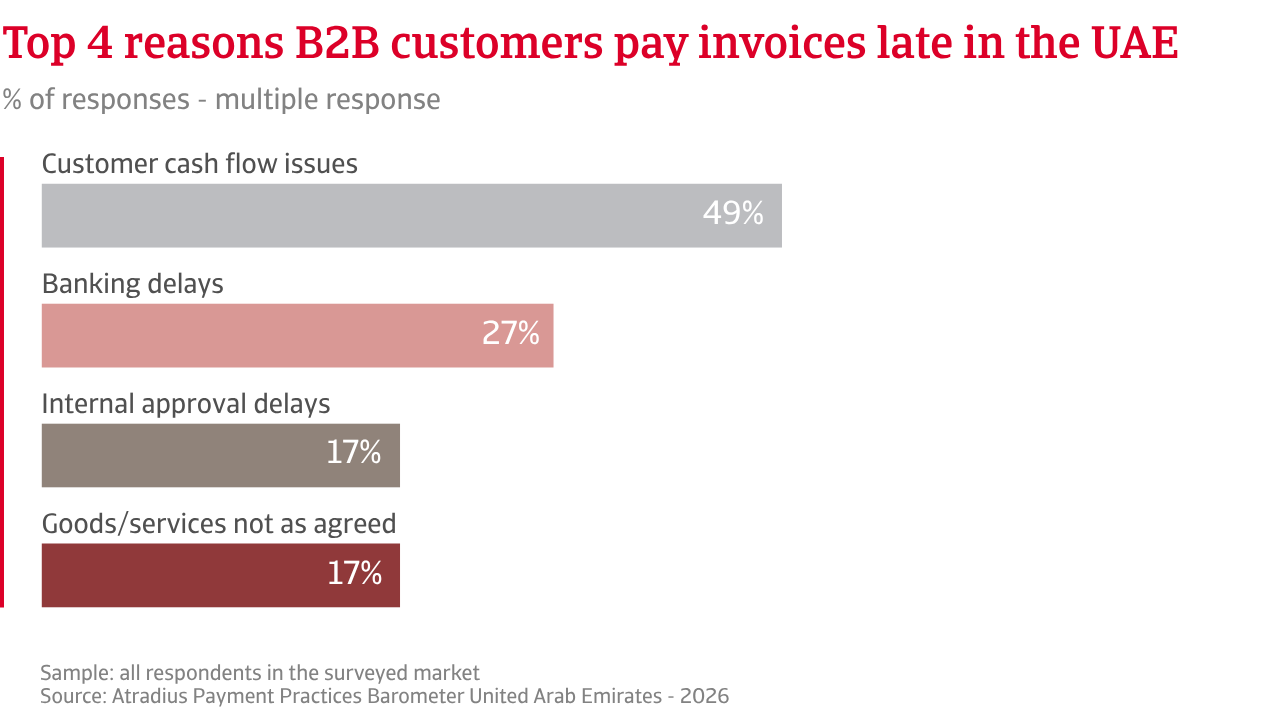
Within this context and reflecting the widespread flexibility in payment policies across the market, delayed payments from B2B customers are reported by almost all companies surveyed in the United Arab Emirates. This translates into roughly two in five invoices being settled late, pointing to significant payment risk and ongoing pressure on cash flow across the market. Businesses in the industrial and construction sectors appear to be the most affected, reflecting their longer and more complex payment cycles. Recent trend data point to a deterioration in B2B payment behaviour in recent months, with more than twice as many firms experiencing rising delays than falling ones. Nearly half of companies across the market, particularly large industrial firms, report that B2B customers delay payments most often due to cash flow constraints.
Once B2B invoices become overdue, collection cycles lengthen significantly in the United Arab Emirates. This is reflected in Days Sales Outstanding (DSO) trends, with more companies reporting longer rather than shorter cycles. Recent data show that this has increased the risk of receivables turning into bad debt write-offs, which now account for just over 2% of B2B receivables. Credit losses are higher among certain segments, particularly larger firms with greater exposure to trade credit. Businesses consistently link write-offs to the ageing of receivables and, increasingly, to customer default, which remains a key driver of deteriorating customer payment behaviour.
Across the United Arab Emirates, delayed payments and bad debts are placing significant strain on working capital, as survey data show. Businesses are increasingly forced to rely on external financing and operate with reduced liquidity, while uncertainty around payment timing disrupts cash flow planning. The impact extends beyond internal operations, with delays cascading through supply chains and limiting firms’ ability to invest and respond to financial needs.
To mitigate the impact of customer payment risk, companies in the United Arab Emirates most often rely on internal buffers such as building bad debt reserves, which involves setting aside funds to cover potential losses, although it ties up liquidity that could otherwise support operations. This is closely followed by active credit management, including credit checks, monitoring and collections, alongside the use of credit insurance to transfer part of the risk. The use of credit insurance is most often reported by larger industrial players. Companies also adopt commercial measures to limit exposure, including requesting upfront payment, offering early payment incentives and tightening payment terms. Customer diversification and receivables financing play a supporting role, helping businesses protect cash flow while maintaining commercial flexibility.
Delayed payments from B2B customers are reported by almost all companies surveyed in the UAE. This translates into roughly two in five invoices being settled late, pointing to significant payment risk and ongoing pressure on cash flow across the market.

Most businesses in the United Arab Emirates anticipate that customers will pay invoices more promptly in the months ahead, reflecting increased confidence in B2B payment behaviour and the prospect of easing liquidity pressures. This suggests expectations of more stable cash flow and a gradual improvement in payment discipline.
At the same time, significant concerns about underlying risk remain. More companies expect customer default levels to increase than to decrease, reflecting continued pressure on the financial resilience of a more vulnerable group of customers. A notable share remains uncertain, pointing to a cautious and divided outlook. Taken together, this highlights a widening gap between stronger customers, who are expected to pay more promptly, and weaker ones, where the risk of default continues to build.
Against this backdrop, profitability expectations appear more resilient. A strong majority of businesses report rising profit margins, indicating that despite ongoing payment risks and elevated credit pressures, many firms are managing to protect or even strengthen their financial performance. This suggests that companies are actively adjusting pricing, cost structures, or commercial strategies to absorb risk, reinforcing a widening gap between stronger, more resilient firms and those more exposed to financial strain across the market.
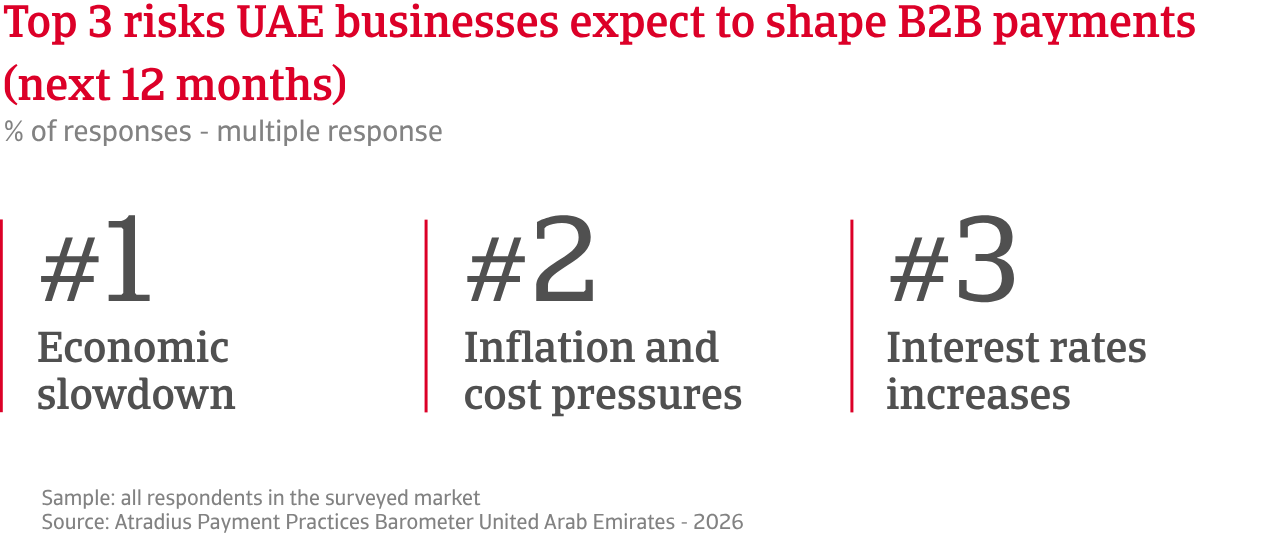
When asked about their view on the factors they expect to disrupt B2B payment behaviour in the months ahead, businesses in the United Arab Emirates most often point to an economic slowdown, highlighting concerns about weakening demand and tighter liquidity across the market. Inflation and rising cost pressures are also cited quite often, alongside higher interest rates, both of which are expected to further strain cash flow and delay payments. Geopolitical instability, cybersecurity threats, and fraud risk are cited by a significant share of firms, underscoring a complex and uncertain operating environment. Taken together, these risks suggest that B2B payment behaviour is likely to remain closely linked to broader economic conditions, with liquidity pressures continuing to drive delays and increase the risk of default across the market in the months ahead.
For a full overview of the 2026 survey results for the United Arab Emirates, please download the market specific report from the related documents section below.
To explore how to strengthen your own credit risk strategy, get in touch with us and see how we can help you stay ahead.
